

The value chain

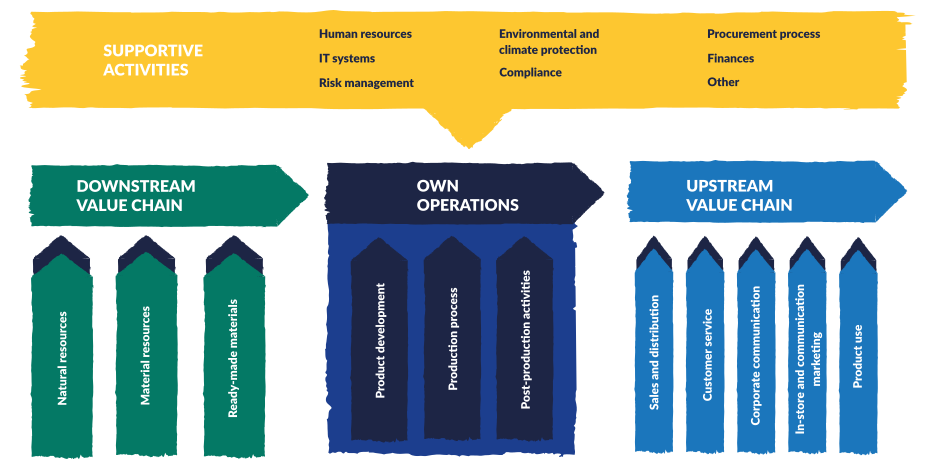
The Śnieżka Group identifies its value chain divided into upstream and downstream parts, own operations and supporting activities, as well as entities with which it establishes and maintains business relationships at individual levels.

śnieżka_grafiki_EN_value_chain śnieżka_grafiki_EN_value_chain

The Śnieżka Group identifies its value chain divided into upstream and downstream parts, own operations and supporting activities.

Essential activities, resources and relationships in the upstream value chain

At this level of the value chain, the Group acquires natural resources, materials and finished goods. Crucial natural resources from the perspective of the Group’s daily operations are as follows:

  • water used for technological and social purposes, supplied by the water supply network
    (and in the case of Rafil – also sourced from a drilled well),
  • renewable energy used in production processes, both purchased from suppliers and generated for own needs using own photovoltaic systems,
  • fossil fuels in the form of diesel and heating oil, LPG, coal and natural gas, used primarily for transport and heating purposes,
  • wood – in the form of pallets and as an energy material,
  • raw materials of natural origin, e.g. mechanically processed gypsum, sand, aluminosilicates, kaolin, talc, lime, pigments.

An important component of Śnieżka products are material resources: synthetic pigments, binding agents, adhesives, solvents, synthetic gypsum, resins and vegetable oils (refined oils are also used), preservatives, stabilizers, binding agents and various types of additives and auxiliary substances. The vast majority of materials come from the European Union and the United Kingdom. Only a small part of the raw materials comes from Asia, North and South America.

The third category of acquired resources are finished materials. In terms of the product itself, the most important packaging is plastic and metal – both types contain recycled raw materials. The Group also takes advantage of paper and cardboard packaging. Protective films are used in transport and storage processes. The finished materials purchased by the Group also include all machines and equipment used in production, post-production processes and for research and development.

In order to obtain the above resources, individual companies of the Group establish rapport with appropriate external suppliers. For many years, the Śnieżka Group has been collaborating with trusted, proven suppliers, also verified in terms of business ethics, which is described in more detail in Chapter Business.

Essential activities, resources and relationships within the Group’s own operations

Own operations are focused on processes related to the product. First of all, it is product design based on market analysis and customer needs research. The next stage involves determining the recipe composition, i.e. selecting raw materials based on, inter alia, the specification, impact on the environment, expected parameters and availability. Work in this area is carried out in our own research laboratories. After passing the tests, the product goes into production.

Key elements of the production process

śnieżka_grafiki_EN_product_packing śnieżka_grafiki_EN_product_packing

As part of own operations, Śnieżka also highlights post-production activities. They include: quality control, packaging, storage, internal transport (between warehouses), washing of tanks used for production, including the use of rinsing, and processing of waste from production and post-production processes themselves.   

Essential activities, resources and relationships in the downstream value chain

At this stage, products are sold and distributed to B2B customers: including wholesalers and warehouses of construction materials, DIY markets, retail stores and via e-commerce. Deliveries to customers are handled depending on an entity – personal collection by the customers themselves or by the Group, which takes advantage of third party services in this respect.

The Sales Support Centre department is responsible for customer service: handling complaints, answering questions about products, collecting and analysing partner feedbacks as well as processing orders and transactions.

Activities in the downstream value chain also include processes such as market and consumer behaviour analysis (carried out by internal departments), communication marketing and in-store marketing. The Group develops materials necessary to implement the above-mentioned activities mainly based on internal resources.
A related process is corporate communication, i.e. taking care of the corporate brand image, including the creation and monitoring of media messages, carried out with the support of external companies.

The downstream value chain also includes the use of products by consumers.

Essential activities, resources and relationships among supporting activities

The group also identifies activities and processes that support the day-to-day operation of the undertaking, although they are not directly related to the production process. Most supporting activities are carried out within internal processes.

  • Human resources management, including recruitment, employee development and occupational health and safety issues.
  • Environmental and climate protection management – ​​monitoring and reporting of emission indicators, reporting to Supervisory Authorities (e.g. KOBiZE – National Centre for Emissions Management).
  • Purchasing process – analysis of direct and indirect suppliers as far as compliance with specific criteria is concerned, including ESG criteria contained in the Supplier’s Code of Conduct.


  • Supervision over compliance with the law and ensuring consistency and transparency of documentation by introducing policies, procedures and internal regulations in line with corporate governance.
  • Supervision over cybersecurity, development of IT systems, investments and management of the Group’s infrastructure, which is crucial to maintaining the continuity of production, sales, purchasing and other processes.
  • Other: financial management, risk management, property protection and cleaning services, trademark and intellectual property management, CSR activities, etc.