
Greenhouse gas emissions

[E1-6]

Greenhouse gas emissions in 2024 show a decrease by 0.72% compared to 2023, in which an adjustment was considered, i.e. 49.97 tCO2e was added from the consumption of LPG gas for Śnieżka SA not included in the previous year. If the adjustment of 2023 was not taken into account, current Scope 1 emissions would increase by 1.88%.

śnieżka_grafiki_EN_emisje_gazów_2025 śnieżka_grafiki_EN_emisje_gazów_2025

No targets have been set for Scope 3 due to the lack of a transformation plan to be presented by the end of 2026. No targets have been defined in Scopes 1 and 2 for 2025, 2030 and 2050 for the entire Group, while the targets adopted for 2025 for FFiL Śnieżka SA and Śnieżka ToC have already been achieved.

Carbon footprint of the Śnieżka Group

Base year 2020 Information regarding past
N
2024
N-1
2023
N/N-1
change y/y [%]
Scope 1 and 2 greenhouse gas emissions
Gross Scope 1 greenhouse gas emissions (tCO2e) 4 512.5 3 322.57 3 458.86 -3.94%
Percentage of Scope 1 greenhouse gas emissions from regulated emissions trading systems (%) n/a n/a n/a n/a
Gross Scope 2 greenhouse gas emissions according to the location-based method (tCO2e) 7 897.31 4 224.02 5 455.82 -22.58%
Gross Scope 2 greenhouse gas emissions according to the market-based method (tCO2e) 4 911.25 573.96 1 120.22 -48.76%


N/A - not applicable


Base year 2024
Scope 3 greenhouse gas emissions 
Total gross indirect (Scope 3) greenhouse gas emissions (tCO2e) 134 561.61
1 Purchased goods and services 119 749.28
2 Investment goods 3 753.83
4 Upstream transport and distribution 3 581.70
5 Waste generated by the operation 1 533.90
12 Processing of sold products at the end of their useful life 5 942.90
Total greenhouse gas emissions  
Total greenhouse gas emissions (location-based method ) (tCO2e) 142 108.20
Total greenhouse gas emissions (market-based method ) (tCO2e) 138 458.14

[W1]

The own indicator was calculated in accordance with the methodology adopted for the Śnieżka Group in Scope 1 and 2.

Information regarding past
Base year  N 2024 2023 N/N-1
zmiana r/r [%]
Scope 1 greenhouse gas emissions
Gross Scope 1 greenhouse gas emissions (tCO2e) 1 968.1 1 943.55 1 957.67 -0.72%
Percentage of scope 1 greenhouse gas emissions from regulated emissions trading systems (%) n/a n/a n/a n/a
Scope 2 greenhouse gas emissions  
Gross Scope 2 greenhouse gas emissions according to the location-based method (tCO2e) 4 647.55 3 404.45 4 321.62 -21.22%
Scope 2 greenhouse gas emissions according to the market-based method (tCO2e) 3 545.24 0 0 0.00%
Scope 1 and 2 greenhouse gas emissions according to the location-based method (tCO2e) 6 615.65 5 348.00 6 279.29 -14.83%
Scope 1 and 2 greenhouse gas emissions according to the market-based method (tCO2e) 5 513.34 1 943.55 1 957.67 -0.72%
N/A - not applicable

Emission source Emission type Consumption (t) Biogenic emissions (tCO2)
Biomass (wood) Burning 101.76 146.15
Fuel emissions (diesel) Burning 70.92 13.79
Fuel emissions (petrol) Burning 309.93 53.24

Greenhouse gas emission intensity per net revenues N 2024 N-1 2023 N / N-1
change y/y [%]
Total greenhouse gas emissions (according to the location-based method) per net revenues (tCO2 e /PLN ‘000) 0.178 0.173 2.89%
Total greenhouse gas emissions (according to the market-based method) per net revenues (tCO2 e /PLN ‘000) 0.173 0.167 3.59%

The net revenue amount shown is in line with the item Sales revenues item (described in note 3.2.1 of the Consolidated Financial Statements of the Śnieżka Group for 2024).

  • The Greenhouse Gas Protocol A Corporate Accounting and Reporting Standard Revised Edition,
  • GHG Protocol Scope 2 Guidance,
  • Corporate Value Chain (Scope 3) Accounting and Reporting Standard,
  • European Sustainability Reporting Standards (ESRS).

The GHG Protocol methodology was selected as it is the global and most widely used standard for measuring, reporting and managing greenhouse gas emissions. The organizational boundaries of the GHG emission calculations covered the activities of the Śnieżka Group, divided into companies: FFiL Śnieżka SA, Śnieżka Trade of Colors Sp. z o. o., RAFIL SA, Poli-Farbe Vegyipari KŌ., Śnieżka-Ukraina Sp. z o. o., Śnieżka-BelPol Sp. z o. o. The results were consolidated according to operational control at the Group level, thus accounting for 100% of emissions from each company. The data on the basis of which the calculations were made came from internal registers and companies’ data.

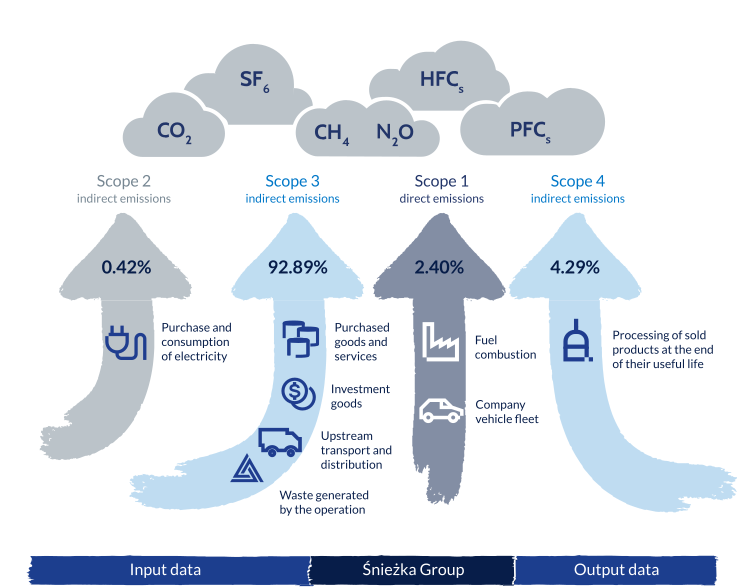
The majority of the Group’s greenhouse gas emissions come from the downstream and upstream value chain (Scope 3), accounting for 97.19% for the market-based method and 94.69% for the location-based method, respectively. The remaining emissions from own activities (Scope 1 and 2) have a relatively lower impact of 2.81% for the market-based method and 5.31% for the location-based method.

Scope 1 includes all direct greenhouse gas emissions from sources owned or controlled by an undertaking and enables the precise identification of an undertaking’s direct impact on greenhouse gas emissions.

Reporting of Scope 1 CO2e emissions is conducted in accordance with ESRS and GHG Protocol standards.  Scope 1 covers direct GHG emissions arising from facilities owned or controlled by the undertaking. It includes emissions resulting from fuel combustion, release of refrigerants, and other fugitive emissions, e.g. resulting from the use of selected technical gases, and biogenic emissions relating to out-of-scope emissions from the combustion of primary fuels based on bioadditives. Emissions from regulated Scope 1 emissions trading systems are not included. It was assumed that the amount of refrigerant corresponds to the amount of refrigerant replenished in the installation based on the refrigerant replenishing protocols. The emission factors used in the calculations for individual types of fuels, refrigerants and technical gases are the latest available and come from KOBiZE (National Centre for Emission Balancing and Management) and the DEFRA (The Department for Environment, Food and Rural Affairs) database. CO emissions from bioadditives in fuels are included but disclosed separately under biogenic emissions. Scope 1 emissions were calculated using a previously developed carbon footprint calculator in an Excel file, and the consumption of individual utilities in the Śnieżka Group companies is based on invoice readings. No significant assumptions were made in the calculation of scope 1 emissions. There are no emissions from sources other than the consolidated companies.

Scope 2 includes indirect greenhouse gas emissions that are associated with the electricity, heat or steam and cooling purchased and consumed by an undertaking. This includes emissions from power or heating plants that supply energy to the undertaking.  This scope allows for assessing the impact of an undertaking’s electricity consumption on greenhouse gas emissions.

Reporting of Scope 2 CO2e emissions is conducted in accordance with ESRS and GHG Protocol standards.  Scope 2 includes indirect emissions related to the generation of electricity purchased by the undertaking.  Emissions from electricity production were calculated according to the two methods mentioned above, i.e. location-based, which is based on the average emission indicator for a given country, i.e. it presents the actual amount of emissions generated in a given area, and market-based, which uses emission indicators published by specific energy sellers, which shows the impact of the undertaking’s purchasing decisions on the carbon footprint. The calculations take into consideration the green energy used in two companies, originating from renewable sources, which was provided with 100% guarantees of origin and documents confirming their redemption issued by the Polish Power Exchange. This allowed these companies to achieve zero scope 2 carbon footprint emissions using the market-based method. The emission factors for electricity used in the calculations are the latest available and come from KOBiZE (National Centre for Emission Balancing and Management) and the IRENA (International Renewable Energy Agency) database. In the absence of a guarantee of origin for other companies of the Śnieżka Group, the average national emission factors were applied. Scope 2 emissions were calculated using a previously developed carbon footprint calculator in an Excel file, and the electricity consumption in individual companies of the Group is based on invoice readings. There is currently no precise information on whether the adopted emission factors separate the percentage of biomass or biogenic CO2. There is also no precise information on the amount of biogenic emissions that make up Scope 2, hence an indication of the percentage of biogenic emissions is not possible. There are no emissions from sources other than the consolidated companies.

Scope 3 includes all other indirect greenhouse gas emissions that result from the undertaking’s activities but come from sources that are not owned or controlled by the undertaking.  This scope allows for a comprehensive assessment of the undertaking’s impact on greenhouse gas emissions across the entire value chain.

Reporting of Scope 3 CO2e emissions is conducted in accordance with ESRS and GHG Protocol standards.  Calculation methods consistent with the GHG Protocol include the expenditure-based method, the supplier-specific method, the average-data method and the distance-based method. Out of the fifteen scope 3 categories defined by the GHG Protocol, the Śnieżka Group, assuming a cut-off level of 1%, considered five categories as substantial, i.e. categories 1, 2, 4, 5, 12. The remaining ten categories (i.e.: 3, 6, 7, 8, 9, 10, 11, 13, 14, 15) are not relevant to the operations of the Śnieżka Group due to their low share of emissions (below 1%) and no impact on stakeholders. The main sources of emission indicators include DEFRA, EXIOBASE, Ecoinvent, NAICS databases and indicators sourced directly from suppliers. Scope 3 emissions, where primary data from suppliers or other value chain partners is used in the calculation, include the portion (10%) of category 1 emissions related to purchased raw materials. Scope 3 emissions for each substantial category were calculated using a previously developed carbon footprint calculator in an Excel file. There is also no precise information on the amount of biogenic emissions that make up Scope 3, hence an indication of the percentage of biogenic emissions is not possible.

Includes cradle-to-gate emissions arising during the production stage of raw materials, commercial materials and services (intangible products) purchased by the undertaking.  All raw materials acquired externally were included in the carbon footprint of the company making the purchase. As far as the internal flow is concerned, attention was paid to not to duplicate the value of a given raw material, i.e. the consumption of this raw material should be included in a company to which it is ultimately addressed. Raw materials were categorised into material groups with their weights, and carbon footprint calculations for services and commercial materials were performed using emission factors based on monetary values.

Includes emissions that arise from the production phase of capital goods purchased or acquired by the undertaking.  These include buildings, technical equipment and machinery, vehicles and their modernization.  Capital assets are used by an undertaking to manufacture a product, render a service, or sell, store, and deliver goods. They generally have a long useful life. The calculations were divided into two approaches – in the case of expenses for which the weight can be easily identified, it was decided to use physical emission factors (e.g. vehicle purchases, electronic equipment). In other cases, monetary emission factors were used.

Includes the carbon footprint of supplies of purchased raw materials and emissions resulting from the provision of transportation and distribution services purchased by the undertaking i.e. transportation of finished products, the cost of which is borne by the undertaking.  Only transports carried out by external companies are taken into account, and the fuel consumption of the own fleet is reported in Scope 1. Emission calculations were made based on the number of tonne-kilometres [tkm] travelled by a specific means of transport.

Represents emissions generated during the waste management stage resulting from the undertaking’s activities. According to the standard, emissions generated during waste storage are included in the calculation limits. In order to calculate the carbon footprint of this category, appropriate amounts of waste generated were introduced, considering: the location in which the waste was generated (this applies to companies with more than one branch) and the type of waste treatment.  For calculation purposes, three types of waste treatment were distinguished: reuse, recycling and disposal/landfilling. As for recycling or reuse by external entities, only emissions resulting from transport to the recycling/reuse site, as well as possible emissions related to waste pre-treatment, are reported. The method of management of specific waste codes was obtained from waste collection companies.

Identifies emissions related to the disposal and treatment of products sold by an undertaking at the end of their life cycle. The carbon footprint in category 12 was determined by including the packaging introduced to the market and the dry weight of products that will be stored in the future. In term of the packaging, both waste collection and recycling were taken into account. It was also assumed (based on expert engineering practices) that approximately 5% of solvent products would remain in metal packaging and would be burned during steel recycling. An average elemental carbon content of 70% was assumed for them (HDPE has a content of approximately 84%).

[E1-7] 

The undertaking does not currently conduct, and has not conducted, greenhouse gas removal or storage projects as part of its own operations. It has not participated or is not participating in any such projects in its upstream or downstream value chain. The Group is currently unable to disclose the amount of greenhouse gas emission reductions or greenhouse gas removals resulting from climate change mitigation projects outside its value chain or through the purchase of carbon credits as it has not undertaken such activities or calculations.

[E1-8]

The undertaking does not currently apply internal carbon pricing systems.

[E1-9] 

The Śnieżka Group takes advantage of the possibility to omit the disclosure of information on the anticipated financial impacts resulting from material physical and transition risks and potential climate-related opportunities in accordance with Appendix C to Commission Delegated Regulation (EU) 2023/2772 of 31 July 2023, due to the fact that it is preparing a report in accordance with the ESRB requirements for the first time.